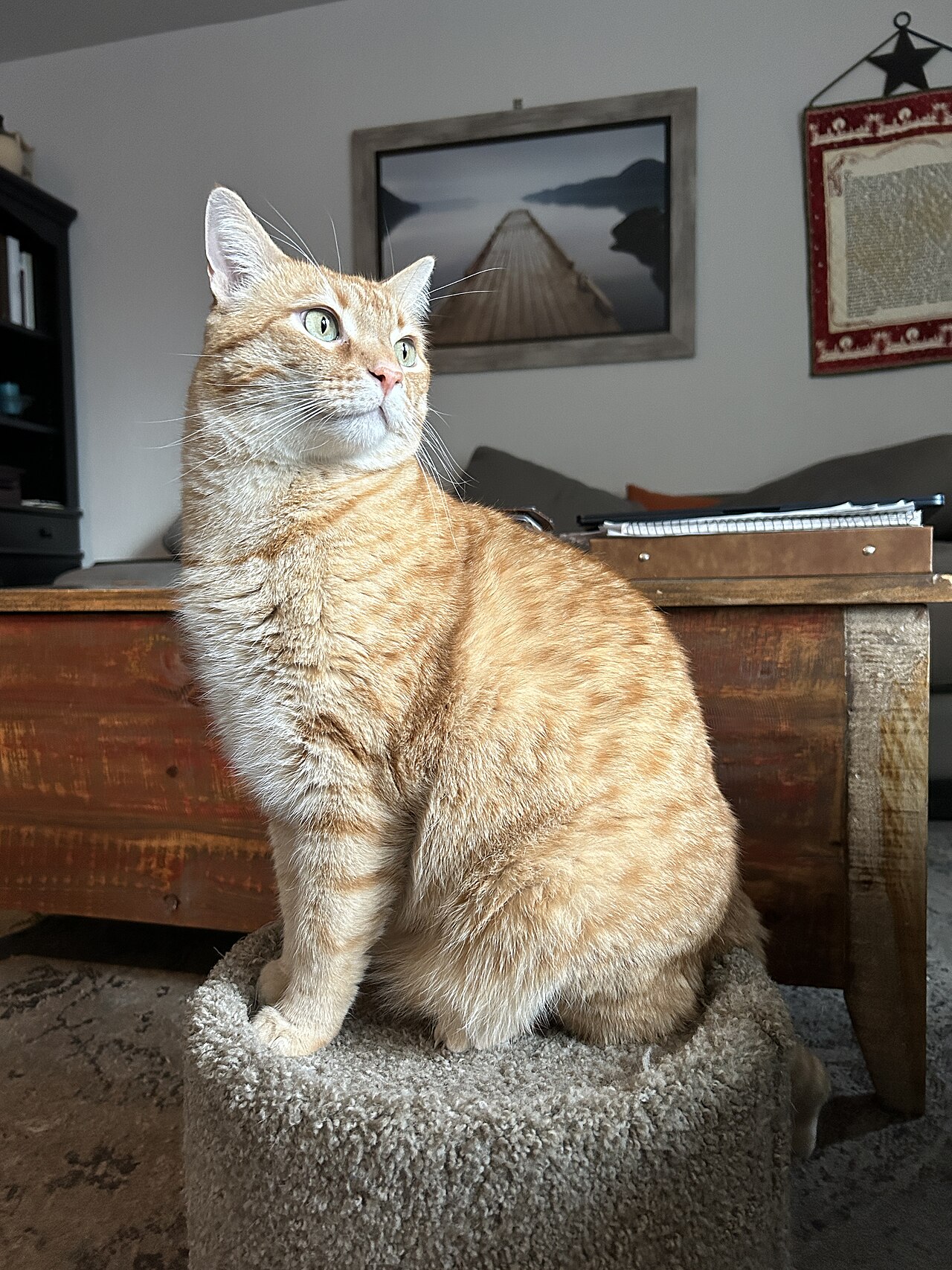
Stunts on a Budget: How We Filmed the Great Curtain Climb

One of the most memorable scenes in our film Curtain Call was the Great Curtain Climb, a dramatic ascent filmed in a single take by a stunt cat known only as Zig. This is the story of how it was done.

Preparation

Stunt work begins with safety. Our stunt coordinator, a one eyed Siamese named Captain Zoomer, inspected the curtain, the rail, and the floor beneath. He found the curtain to be heavy, the rail to be loose, and the floor to be underneath. He signed off at once.

The rig

We did not use wires, because we did not have any. We used the following equipment instead:

  • A large cushion at the base of the curtain, in case of a fall
  • A smaller cushion at the base of the large cushion, in case of a fall from the large cushion
  • A tin of fish held at the top by a crew member on a stool, as motivation
  • A blanket draped over the rail, to prevent the curtain from collapsing before the end of the take

The technique

Zig began on the floor, looked up and froze for eleven seconds. This was not planned, but it looked excellent on camera. He then jumped onto the curtain with all four paws and began to climb, stopping every third step to ask himself what he was doing.

At the halfway point, the curtain began to sway. Zig reacted instantly by climbing faster. This increased the sway. He reacted by climbing faster still. The camera crew, led by Gaffer Gary, applauded.

The summit

Zig reached the top of the curtain after thirty seconds. He sat on the rail, surveyed the room, and gave a small, victorious meow. There was only one problem: he had not planned how to get down.

The descent

The descent was less glamorous. Zig clung to the curtain and slid downwards, in a long, loud, ripping motion, and landed on the cushion. He stood up. He licked a paw. He walked off set as though nothing had happened.

Aftermath

The curtain was removed from the set and is now on display in our lobby, labelled “Historic Damage.” Zig has retired from stunt work and now teaches climbing at the local nursery, where he is described as an inspiration and a risk.

Safety notice

No viewer should attempt a curtain climb at home. If you do, please be aware that the curtain will not forgive you, and nor will the person who owns it.

Furlough Film Studio is a fictional company. This account is invented, though the curtain is based on a real one that lost.
The Director’s Chair: Why Every Cat Insists on Sitting in It

There is a chair on every film set. It has a canvas back, a folding frame, and the director’s name on it in large letters. At Furlough Film Studio this chair is the most contested object in the building, and it has never once been used by a director.

The history of the chair

The chair arrived in our office on the first day of production, a gift from a supplier who wished us well. Orson Whiskerton, our founder, approached it with great ceremony. He walked around it twice. He sniffed the seat. He climbed in. Within four minutes he was asleep, and a new tradition was born.

Why cats love it

There are several reasons why cats are drawn to the director’s chair.

  • It is raised off the floor, offering a view of the entire set
  • It is slightly unsteady, which is exciting
  • It carries the scent of authority, which is mainly Orson
  • It is canvas, which is excellent for kneading
  • It has a name on it, and a cat enjoys being mistaken for someone important

The rules

To avoid conflict, we have introduced a set of rules.

1. The chair belongs to whoever is in it
2. A cat that leaves the chair for any reason loses the chair
3. A cat that returns to the chair finds another cat in it
4. This is the director’s fault

Directing from the chair

On the rare occasions when a decision is required, Orson gives his orders from the chair. These are usually delivered in the form of a slow blink, which the crew interprets as “carry on.” Some interpret it as “I have no idea.” Both are valid readings of the situation.

A day in the life

At 6 AM the chair is empty. At 6:05, Gaffer Gary is in it. At 6:30, Fluffy Coppola has pushed him out and taken the seat. At 8, the whole crew is gathered around, waiting for a decision, and the chair holds two cats and a sleeping hat.

What the chair teaches us

The director’s chair teaches us that authority is not a position but a posture. It is the manner in which you sit, the angle of your tail, and the firmness with which you refuse to be moved. By this measure, every cat in the studio is a director, and none of them is making a film.

Furlough Film Studio is a fictional company. The chair is real, in that it exists in our imagination and sags in the middle.

Pitch Meeting: How We Greenlit ‘The Long Nap’

Every film starts with an idea. Ours began with a cushion. This is the story of how our board came to approve The Long Nap, a three hour epic in which a cat falls asleep on a sofa and wakes up in a slightly different position.

The room

The meeting was held in the Boardroom, which is also the Sofa. Present were our founder and director Orson Whiskerton, a stately tabby with an air of tired genius; producer Fluffy Coppola, a cream Persian who asks few questions and eats the answers; and Gaffer Gary, a black cat in charge of the sunbeam, who attended from the windowsill.

The pitch

Orson began by laying out his vision. “The film opens on a sofa,” he said. “Nothing happens for ten minutes. Then a cat arrives. The cat turns around three times. The cat lies down. We hold on the cat for the next two hours and forty minutes.”

There was a long silence. It was the silence of a room full of professionals who had seen something very similar before and wanted to see it again.

Objections

Fluffy Coppola raised several concerns.

  • Would there be a plot? Orson said the plot was the sofa.
  • Would there be a villain? Orson said the villain was the vacuum cleaner, which would appear in a single frame near the end and be hissed at.
  • Would there be a love story? Orson said the love story was between the cat and the warm patch.
  • Would there be a soundtrack? Orson said there would be purring, mixed at seventy decibels.

The vote

The motion to approve was carried by a majority of two to nothing, with one abstention from Gaffer Gary, who had gone to sleep during the second hour of the vote.

Budget

The film was budgeted at twelve tins of fish and a decent cushion. The cushion was eventually supplied by the director himself, who has stated that he will not be paid and will not be moved.

Why we believe in it

The Long Nap is not a story about sleep. It is a story about what happens when we stop trying to do anything at all. We believe audiences everywhere, and especially those of the cat variety, will understand it instinctively.

Furlough Film Studio is a fictional production company shooting entirely from the sofa. No actual films are produced and no actual cushions were harmed in the making of this meeting.